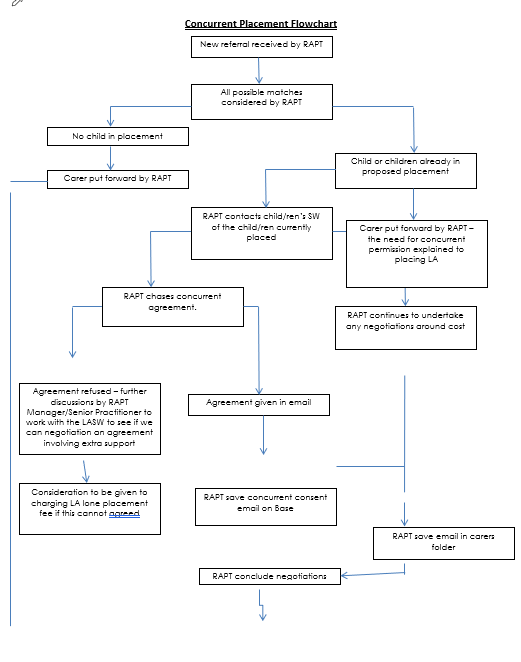
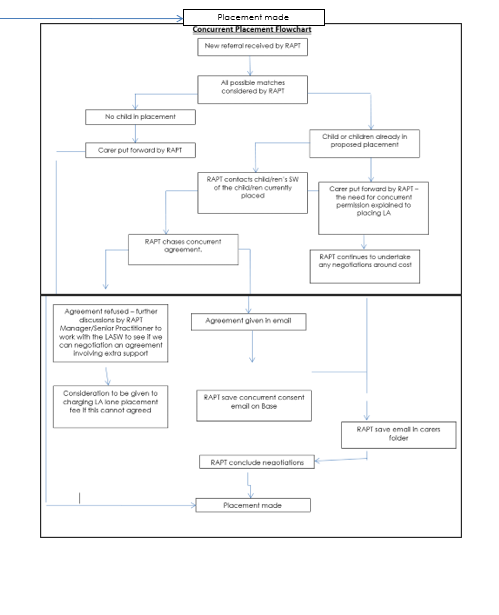
When a new placement is made and there is already a child or children in placement, RAPT (Placement Team) and the Supervising Social Worker (SSW) must carefully and collaboratively consider whether concurrency (the placement of more than one child or sibling group in the same foster home) is in the best interests and emotional wellbeing of the child or children currently in placement.
This decision-making process must be guided by principles of safety, stability, and trauma-informed care, ensuring that each child’s voice, background, and emotional needs are recognised and respected.
- This should be considered jointly by RAPT and the relevant SSW during the matching process.
(Please refer to the Matching Procedures for further information.)
Gaining Agreement for Concurrent Placements
In many situations, the child currently in placement may have been placed by another Local Authority. Therefore, we have a statutory and ethical duty to seek agreement for all concurrent placements from the child’s allocated Social Worker (SW). This ensures that both the care and safety needs of all children in the home are understood and upheld.
It is the responsibility of RAPT to obtain specific concurrent consent prior to confirming the new placement.
- This consent must be obtained prior to the start of the new placement, unless the placement is made in an emergency on the same day or out of hours.
- Where an emergency placement (same day or out of hours) occurs, obtaining concurrent consent must be treated as a priority task, recognising that prompt communication supports the emotional safety of everyone involved.
Emergency Concurrent Placements
In situations where an emergency placement is made, RAPT will seek concurrent consent as soon as practicable. RAPT will email the allocated Local Authority Social Worker (LASW) and copy in the SSW with the following information:
- Age of the child.
- An outline of the reason for being in care (written in neutral, factual language, avoiding judgemental or deficit-based wording).
- Confirmation that there are no known behaviours which present a risk to the existing children in the foster carer’s care.
- Any other relevant information needed for safeguarding or support planning.
- Clarification that the SSW will proactively monitor the wellbeing of all household members and offer emotional and practical support to address any challenges or changes in family dynamics.
Any information shared will be on a “need-to-know” basis, in line with data protection principles, and will be appropriately anonymised where possible to maintain confidentiality and dignity.
The RAPT officer who made the placement is responsible for:
- Ensuring concurrent consent is obtained and documented.
- Regularly following up if consent is delayed.
- Uploading all correspondence and evidence of communication to Base, ensuring transparency and auditability.
Longer-Term and In-Principle Concurrent Agreements
For some longer-term placements, and where appropriate, it may be advantageous to obtain an “in principle” agreement for placing another child concurrently in the future. This can help plan transitions thoughtfully and reduce anxiety for carers and children.
Where this is appropriate:
- The SSW should take the lead in obtaining this in-principle agreement, as they often have a trusted working relationship with the child’s social worker.
- The SSW must share any such agreements with RAPT to ensure consistent record keeping and coordination.
Even with an “open” or in-principle agreement, the agency still has a duty to notify the Social Worker of the child or children already in placement whenever a new child is being considered.
- It may still be necessary to obtain specific written consent for each concurrent placement to ensure full transparency and safeguarding.
- Where specific concurrent consent is required, the procedure described above must be followed, and RAPT will retain responsibility for obtaining this.
Trauma-Informed Practice Expectations
All professionals involved in concurrent placement decisions must:
- Approach discussions with empathy, sensitivity, and transparency, recognising that placement changes and new arrivals can be unsettling for children who have experienced trauma or instability.
- Prepare foster carers and children emotionally for concurrent placements through open discussion, reassurance, and practical planning.
- Be alert to changes in household dynamics, ensuring that each child continues to feel seen, safe, and supported.
- Use reflective supervision and communication between RAPT and SSWs to identify and respond early to stressors or emotional overload within the household.