
(Last reviewed 18/06/2026)
Introduction
Positive Aspirations is dedicated to making sure every child in our care is safe from harm. The agency recognises that safeguarding is everyone’s responsibility and is committed to nurturing a culture of safety, respect, and compassion for the children we support. This policy sets out our approach to safeguarding children, in line with national legislation, guidance, and local procedures.
Legal Framework
This policy is informed by and adheres to the following key pieces of legislation and guidance:
- Fostering Services (England) Regulations 2011: Regulation 11, 12, 13
- The Children Act 1989: Guidance and Regulations Volume 4
- The Children and Young Persons Act 2008
- National Minimum Standards (NMS): Standards 4, 5, 22
- Children Act (2006) S.11 (2004)
- Working Together to Safeguard Children (2026)
- Information Sharing: Guidance for Practitioners and Managers (2015)
- The Online Safety Act 2023
- Local Safeguarding Children Partnerships:
9a. London Safeguarding Children’s Partnership (LSCP) – GLF & SCF
9b. Lambeth Safeguarding Children’s Partnership – GLF
9c. Hertfordshire Safeguarding Children Partnership – FH - Children’s Wellbeing and Schools Act 2026
Policy Statement
At Positive Aspirations, the safety, wellbeing, and best interests of every child and young person we care for remain our top priority. We are committed to keeping all children safe from harm and to actively promoting their wellbeing at all times.
All staff members, foster carers, volunteers, and independent professionals linked with the agency share a collective duty to report any actual or suspected abuse involving a child or young person placed through our service.
In line with the Children Act 1989 and 2004, we recognise the need for immediate action when there is concern that a child is experiencing, or is likely to experience, significant harm. We are equally committed to supporting children in need, even when they are not currently at risk. Staff and foster carers play a vital role in identifying concerns early and providing timely support to stop issues from escalating.
As part of the wider safeguarding framework set out in Working Together to Safeguard Children (2026), our agency collaborates actively with local authorities, social care teams, police, health professionals, and other partners to ensure a coordinated and effective response to child protection and welfare.
Safeguarding lies at the heart of our responsibilities to children placed with our foster carers. Every child has the unquestionable right to live free from abuse, exploitation, and harm. If any child discloses or shows signs of mistreatment, we ensure they receive a prompt, sensitive, and tailored response.
All individuals connected to the agency—employees, foster carers, volunteers, and independent contractors—must understand their specific safeguarding roles. This awareness is embedded in all employment terms and the Foster Care Agreement.
This policy applies across the agency and sets out clear lines of accountability, from individual staff members up to the Responsible Individual. It is shared openly with all relevant stakeholders, including Local Safeguarding Children Partnerships (LSCPs), supervising social workers, foster carers, and professionals involved in the care of looked-after children.
We also recognise that some children may face higher risks because of factors such as race, disability, gender, age, religion, sexual orientation, social background, or culture. Our safeguarding approach considers these additional vulnerabilities to provide inclusive and equitable protection for every child.
Purpose of Policy and Procedure
The purpose of this policy and its accompanying procedures is to give clear guidance to all staff, foster carers, and professionals associated with the agency. It ensures a shared understanding of the actions required to safeguard and protect children and young people in our care, and sets out what each person can expect from others in meeting this responsibility.
This policy aligns with statutory guidance, including Working Together to Safeguard Children, and highlights the importance of strong safeguarding systems in preventing and reducing the risk of abuse, neglect, and exploitation. It underscores our duty to protect all children placed through the agency from harm and to actively promote their wellbeing.
The agency follows strict child-protection procedures in every situation where there is a disclosure or suspicion of abuse—physical, emotional, or sexual—neglect, or child sexual exploitation (CSE). These procedures ensure a consistent, timely, and appropriate response to any safeguarding concern.
To maintain high standards of awareness and competence, all agency staff and foster carers must complete regular mandatory safeguarding training at least every three years. Designated safeguarding leads and senior staff undertake advanced safeguarding training with local authorities. Safeguarding education is a key part of the foster-carer induction process, with ongoing updates reflecting changes in legislation, policy, and best practice.
Please refer to the following policies and procedures documents:
Safeguarding policies that have their own Risk Matrices and specific RAG rating on the Risk Register:
- Child Criminal Exploitation
- Child Sexual Exploitation
- Child Trafficking
- Gang Affiliation
- Missing from Care
- Parent and Child Placements
- Radicalisation and Extremism
- Self-Harm
Other safeguarding policies and procedures:
- Female Genital Mutilation
- Allegations and Complaints
- Social Media
- Recording Policy & Procedure
- Supervision of foster carers
- Complaint Procedures
- Whistleblowing
- Restraint & Physical Intervention
- Looking after a child with additional needs
- Risk assessment & risk management policy
If any form of abuse is disclosed, or staff notice signs or indicators suggesting abuse, or any member of staff is worried about the welfare or safety of a child, they must immediately discuss this with the Registered Manager or a senior staff member. Registered Managers have the key role in ensuring child-protection procedures are followed when there is a disclosure or suspicion of physical abuse, neglect, emotional abuse, or sexual abuse of any child.
Our Ethos & Principal of Practice
This policy is informed by relevant legislation, statutory guidance, and good-practice guidance. To meet our commitment to safeguard and promote the welfare of children and young people, we take all necessary steps to uphold the safeguards identified in Working Together to Safeguard Children 2026 and therefore adhere to the following principles:
- A clear commitment and line of accountability from senior management to prioritising safeguarding and promoting children’s welfare through both commissioning and service delivery.
- A culture of listening to and dialoguing with children and young people—seeking their views in ways suited to their age and understanding, and using these views in individual decisions and in developing and improving services.
- All children, regardless of age, disability, gender, racial heritage, religious belief, sexual orientation, or identity, have the right to equal protection from all forms of harm and abuse.
- Children feel respected, and their self-esteem is strengthened.
- When we follow procedures and processes, positive outcomes for children and young people remain the priority. Every child has an individual safer-caring policy and risk assessment that reflects their needs and circumstances.
- Recruitment procedures for staff and foster carers address the need to safeguard and promote children’s welfare, including appropriate checks on new staff, foster carers, and independent external staff, and adoption of best practice.
- Staff and foster carers receive training in all aspects of safeguarding children and young people, understand children’s vulnerabilities and risks of harm, and know how to implement safeguarding procedures.
- Arrangements ensure all staff and foster carers undertake ongoing relevant training to carry out their responsibilities effectively.
- We keep this knowledge up to date with refresher training at regular intervals (not exceeding three years), and all staff—including independent external staff—are made aware of the agency’s safeguarding procedures.
- Procedures comply with National Minimum Standards and Regulation 11 and 12, ensuring daily protection of children and young people and compliance with local-authority and inter-agency procedures.
- Arrangements are in place for effective information sharing and inter-agency collaboration to safeguard children and promote their welfare.
- Complaints procedures are clear, effective, and user-friendly, and are readily accessible to all children and young people, including those with disabilities and those who prefer a language other than English. Procedures cover informal as well as formal complaints. Children must be able to raise concerns and suggest improvements, and these must be taken seriously.
To achieve the objectives above and maintain a safe ethos, we will:
- Ensure the safety of children and young people is paramount.
- Listen to children and young people, value what they tell us, and advocate on their behalf.
- Take all reasonable steps to protect children and young people from harm.
- Regularly assess and review emerging risks.
- Take all suspicions and allegations of abuse seriously and respond to them promptly and appropriately.
- Ensure all agency staff and foster carers are recruited and assessed in full accordance with safer-recruitment standards.
- Make everyone’s roles and responsibilities clear.
- Ensure staff and foster carers understand the importance of learning each child’s wishes and feelings and how individual children communicate, whether verbally or non-verbally.
- Counter bullying effectively.
- Maintain rigorous recruitment and selection procedures that set a high threshold to deter abusers.
- Provide effective supervision and support to permanent and temporary staff and foster carers.
- Maintain clear procedures for referring safeguarding concerns about a child to the relevant local authority.
- Ensure contractor staff are properly checked and supervised when on site and/or in contact with children.
- Provide clear procedures and support systems for staff and foster carers to express concerns about colleagues or other carers.
- Maintain a code of conduct that guides staff in their duty to the agency and their professional obligation to raise legitimate concerns about colleagues or managers, with safeguards to protect the “whistle-blower’s” own position and prospects.
- Show respect for diversity and sensitivity to race, culture, religion, gender, sexuality, and disability.
- Ensure staff and foster carers are alert to external risks from individuals who may exploit the additional vulnerability of children living away from home.
Communication and Working Together
The agency will take all necessary steps to make sure its policies, procedures, and processes uphold the essential safeguards set out in Working Together to Safeguard Children 2026:
“Nothing is more important than children’s welfare. Every child deserves to grow up in a safe, stable, and loving home. Children who need help and protection deserve high quality and effective support. This requires individuals, agencies, and organisations to be clear about their own and each other’s roles and responsibilities, and how they work together.”
The agency’s staff and foster carers work closely with colleagues in children’s services departments, Local Children’s Safeguarding Boards, child-protection teams, and other relevant agencies to ensure that any child-protection matters arising during a placement are followed up in line with local procedures and any specific strategies set out in the Placement Agreement.
Any disclosure or allegation of abuse by a child or young person in placement will be reported, without delay, to the child’s local-authority social worker and—if the child is placed outside their home authority—to the relevant local safeguarding-children or child-protection team. Where another child from a different local authority is also in placement, that child’s social worker will likewise be informed. Agency managers will request and keep copies of the agreed Safeguarding Children/Child-Protection Procedures for every area in which the agency approves foster carers and will maintain a comprehensive list of contact names and numbers for safeguarding-children or child-protection team managers, co-ordinators, or departmental link staff—including Out-of-Hours Services—for each authority in the region.
The protection of all children and young people, in accordance with the host authority’s Local Children’s Safeguarding Board Procedures, is the first priority. Alongside these processes, the agency will ensure that foster carers receive appropriate support and supervision, including access to independent advice, during any investigation in which they are involved. Separate procedure and guidance notes are provided for foster carers on Safe Caring, disclosure of sexual abuse, and allegations against foster carers.
The agency recognises that allegations against foster carers often form part of a complex situation and that the time and uncertainty involved in clarifying events can be extremely stressful for foster carers and their families. The agency will share as much information as circumstances allow about any allegation and will ensure carers have independent support, opportunities to share their perspective, and help to learn and move forward once matters are resolved.
If an investigation concludes that a foster carer has abused or failed to protect a child placed with them, the local authority for the area where the foster carers live, the placing authority (if different), and the agency’s Fostering Panel will be informed with a view to withdrawing their approval and de-registration. This may lead to a referral to the appropriate authority.
Where appropriate, the agency will work with the relevant authorities to refer de-registered foster carers in line with the Safeguarding Vulnerable Groups Act 2006, to safeguard other young people from any potential repeat of the situation. Any foster carer who wishes to challenge a Fostering Panel decision under these or any other circumstances may appeal through the agency’s Complaints Procedure and Fostering Panel Procedure and has the right to an Independent Review Mechanism.
Information Sharing
From September 2026 there is a stronger information sharing duty in the Children’s Wellbeing and Schools Act which introduces a cultural shift in how information sharing is understood and practised across sectors.
Under the new duty, Information to safeguard children MUST be shared other than in ‘extremely limited circumstances’.
Roles and Responsibilities
It is not the role of anyone working for the agency to decide whether a child is being abused or has been abused. However, safeguarding is everybody’s responsibility, and all concerns must be acted on so that the appropriate agencies can investigate and, if needed, protect children.
The following procedures and guidance support agency staff when responding to safeguarding concerns and are divided into the following sections:
- What process to follow if staff have any safeguarding concerns about a child
- Advice to foster carers and staff members on what to do when a child makes a disclosure
- The process to follow when an allegation has been made against a member of staff
Designated Persons
While everyone shares safeguarding responsibilities within the agency, the designated safeguarding leads are the Registered Manager and the Responsible Individual. They will ensure:
- That all staff fully understand the agency’s safeguarding procedures
- That Team Managers are supported with safeguarding and that supervising social workers and all other staff have access to each authority’s Local Safeguarding Procedures
- Ongoing liaison with Local Safeguarding Children Boards to maintain compliance
- Resolution of inter-agency issues and effective collaboration with partner agencies
- Strategic leadership in developing and reviewing safeguarding procedures
What is abuse and neglect?
Abuse and neglect are forms of maltreatment that can seriously harm a child’s health, development, and wellbeing. Harm may be inflicted directly, or through a failure to prevent harm, and may occur within family, institutional, or community settings. Adults or other children may be responsible. Statutory guidance defines four main categories of abuse:
Physical Abuse:
Physical abuse may involve hitting, shaking, throwing, poisoning, burning or scalding, drowning, suffocating, or otherwise causing physical harm to a child. It also includes situations where a parent or carer fabricates or deliberately induces illness in a child.
Sexual Abuse:
Sexual abuse involves forcing or enticing a child or young person to take part in sexual activities, with or without violence and whether or not the child understands what is happening. Activities may include physical contact—such as assault or penetration (for example, rape or oral sex)—or non-penetrative acts like masturbation, kissing, rubbing, or touching outside clothing.
Non-contact activities include involving children in looking at or producing sexual images, watching sexual activities, encouraging sexually inappropriate behaviour, or grooming a child in preparation for abuse (including online). Sexual abuse can also involve non-consensual sharing of intimate images and “cyber-flashing” offences, where explicit images are sent to cause humiliation, alarm, distress, or for sexual gratification.
Women and other children can also perpetrate sexual abuse. Increasingly, sexual exploitation is recognised as a significant aspect of sexual abuse, and the agency’s Child Sexual Exploitation Policy must be read alongside this policy.
“Sextortion” (financially motivated sexual extortion) is online blackmail where criminals threaten to share sexual images, videos, or information about a child or young person.
Emotional Abuse:
Emotional abuse is the persistent maltreatment of a child that harms their emotional development. This can include conveying to children that they are worthless, unloved, or only valued for meeting others’ needs; preventing them from expressing views; deliberately silencing them or ridiculing their communication; imposing age- or developmentally inappropriate expectations; over-protection or limiting exploration; preventing normal social interaction; witnessing the ill-treatment of others; serious bullying (including cyber-bullying); or exploitation or corruption. Emotional abuse is present in most forms of maltreatment but can also occur alone.
Neglect:
Neglect is the persistent failure to meet a child’s basic physical and/or emotional needs, likely to result in serious impairment of health or development. Neglect may begin in pregnancy through maternal substance misuse. Once a child is born, neglect may involve a parent or carer failing to:
- Provide adequate food, clothing, and shelter (including exclusion from home or abandonment)
- Protect the child from physical and emotional harm or danger
- Ensure adequate supervision (including using unsuitable care-givers)
- Ensure access to appropriate medical care or treatment
Neglect also includes failing to meet a child’s basic emotional needs.
Some groups of children may be more vulnerable to abuse for various reasons. Vulnerable children include those who are disabled; living with parental challenges such as domestic violence, substance misuse, or mental illness; unaccompanied asylum-seeking children; trafficked children; children affected by gang activity; and looked-after children. Many will require additional support, and some will need protection.
Historical Abuse:
Abuse that occurred in the past can still have a profound impact. Even if a child is currently safe, the person responsible might target them again or harm another child. Historical abuse must therefore be taken as seriously as current abuse and reported using the same procedures and with the same urgency.
Responding to a Safeguarding Concern
Any allegation or concern, including historical concerns shared with a member of staff, must be discussed with that person’s line manager straight away. The Team Manager will then consult the Registered Manager/Designated Manager. If they decide a safeguarding concern exists, they will follow the relevant Local Authority safeguarding procedures and notify the Local Authority children’s social-care team by telephone as a priority. They will also inform Ofsted and the Local Authority Designated Officer (LADO) if an allegation involves a foster carer or staff member.
If the child has an allocated social worker, the referral must be made to that social worker—or their Team Manager. If the child does not have an allocated Local Authority social worker, the referral must be made to the children’s social-care team covering the area where the child usually lives and the placing authority must also be contacted. A written note of the call and the information shared or received must be added to the agency Base, with a copy sent to the Registered Manager.
All initial conversations and decisions must be logged. Out-of-Hours referrals must be made to the children’s emergency duty team and followed up the next morning by contacting the child’s allocated social worker or children’s social-care team. The on-call worker must also inform the Team Manager and Registered Manager immediately.
The Local Authority decides how to proceed. Staff may need to help with the investigation if asked. Working Together 2026 advises professionals to follow up if they are not satisfied with the Local Authority children’s social-care response.
If the concern relates to radicalisation or extremism, consult the Preventing Extremism and Radicalisation policy right away and follow its guidance, including completing an urgent risk assessment using the radicalisation risk matrix.
Advice to foster carers and staff members on what to do if a child discloses
When a child or young person discloses abuse—or indicates they have been harmed—the response is crucial. A poorly managed reaction can affect any future legal process and cause the child further distress. All disclosures, recent or historical, require the same care and seriousness.
If a child discloses abuse, follow this guidance:
- Remain calm. Your reaction shapes how safe the child feels; avoid showing shock, anger, or disbelief.
- Listen carefully and attentively. Allow the child to speak freely, in their own time, without interruption.
- Reassure the child. Affirm that speaking up was the right thing to do and make it clear they are not to blame.
- Avoid questioning. Keep questions to an absolute minimum and never use leading or suggestive questions; your role is to listen, not to investigate.
- Do not criticise the alleged perpetrator. Criticism can confuse the child and may affect their willingness to talk further.
- Explain what will happen next. Tell the child you must share the information with someone who can help keep them safe.
- Record the disclosure accurately. As soon as possible, write down exactly what the child said, noting date, time, and any observations (for example, emotional state or physical signs). Sign the record.
- Report immediately. Follow agency safeguarding procedures and inform your manager without delay, using the internal safeguarding flow chart for next steps.
Additional considerations:
- Ensure the child’s immediate safety. Take urgent steps if you believe the child is currently unsafe.
- Seek medical attention if needed. If the child is injured, they may need to see a paediatrician. Always consult the Registered Manager or senior manager first, and make decisions with the investigating Local Authority.
- Remember: your role is to protect, listen, and report—not to investigate. Handle all disclosures sensitively, respectfully, and according to agency procedures and safeguarding law.
Allegations against Professionals (Staff and Foster Carers)
These procedures apply whenever suspicion or an allegation arises concerning:
- The individual’s work.
- Their own children.
- Other children outside their family.
Whether the concern is current or historical, statutory guidance (2015 & 2004) offers a framework for managing allegations against people who work with children. Use this framework whenever it is alleged that a person who works with children has:
- Behaved in a way that has harmed, or may have harmed, a child.
- Possibly committed a criminal offence against or related to a child.
- Behaved toward a child or children in a way that indicates they may pose a risk of harm to children.
Within the Working Together framework, up to three strands of consideration must be evaluated when an allegation is made about someone who works with children:
- A police investigation of a possible criminal offence.
- Enquiries and assessments by children’s social care about whether a child needs protection or services.
- Possible employer disciplinary action, suspension or performance and conduct procedures.
Depending on the nature and severity of the allegation, these three strands may be investigated simultaneously or sequentially.
Working Together 2026 states that allegations about people who work with children are managed in a coordinated way, not in isolation. Each Local Authority has a safeguarding designated officer or team responsible for overseeing these allegations. These professionals must be experienced and qualified social workers.
If an allegation involves a member of Positive Aspirations staff, inform the person’s line manager, the Responsible Individual, and HR immediately so an investigation can begin and suspension can be considered. The LADO and Ofsted must also be notified right away, along with details of actions taken to keep children safe.
If the allegation concerns the Responsible Individual, Registered Manager, or a Director, must be informed, which will liaise with a senior manager who has no conflict of interest and with the agency Decision Maker. The LADO and Ofsted must also be notified immediately, along with information about measures taken to protect children.
If an allegation is made about a professional from another agency, the agency manager and/or HR must be informed, the LADO must be contacted, and Ofsted must be notified immediately. Keep a secure record of the allegation and Positive Aspirations’ response.
Process of Responding to an Allegation against a Foster Carer, Member of the Household or Support Network, or Parent
Any allegation involving a foster carer, someone in their household or support network, or a parent must be reported to the Team Manager or Registered Manager without delay. If you are unsure whether something is a concern, discuss it with your manager. All actions needed to keep the child safe take priority over other work.
A staff member who receives or becomes aware of a concern or allegation from any source must report it to their Team Manager immediately. If the Team Manager is not available, they must inform the covering Team Manager and the Registered Manager.
The supervising social worker (SSW) completes an incident form and sends it to the Team Manager and Registered Manager. The Team Manager signs and dates the form.
The Team Manager consults the Registered Manager the same day to decide how significant the information is and whether the Local Authority (LA) and the LA Safeguarding Designated Officer need to be told. The discussion threshold with the LA Safeguarding Designated Officer is lower than for general child protection; the harm does not have to be judged “significant.”
If there are concerns about a foster carer or anyone in their household or support network, the Team Manager or Registered Manager consults the LA Safeguarding Designated Officer/LSCB where the foster carers live within 24 hours, and the LA for every child in placement within 24 hours.
The Registered Manager completes the Ofsted notification form within 24 hours (or, if absent, the covering manager does so).
After discussions with the LA and Safeguarding Designated Officer, decisions are made about the children’s safety and whether they stay in the placement or move elsewhere.
Unless there is a good-practice reason not to, SSWs will ask the LA to keep foster carers as fully informed as possible.
The Team Manager or SSW tells the foster carers the outline of the situation—by phone or in person—as soon as possible, then follows up in writing. Foster carers receive:
- Outline of the situation (only limited information that matches the LA investigation).
- Information about support (who can support them and details of independent support).
- The agency’s internal safeguarding procedures (which procedures apply and who will visit).
- Details of LA safeguarding procedures.
At this stage, the LA may decide:
- No further action by the LA.
- Section 47 enquiry/investigation.
- Internal investigation by the agency.
If No Further Action by the LA
The Registered Manager or Team Manager decides whether to review the foster carers’ suitability.
- If no review is needed, no further action.
- If a review is needed because of practice issues:
2a. An intervention or independent social worker carries out a standard-of-care investigation.
2b. An early review is held, then the case goes to the Fostering Panel with a recommendation for either termination of approval or continued approval with a support and action plan.
2c. If the recommendation is termination and referral to the Disclosure and Barring Service (DBS) is required, the Operations Manager or Registered Manager makes the DBS referral.
If a Section 47 Enquiry/Investigation Is Started
- Strategy meetings (and any further meetings) are attended by the Team Manager and SSW.
- The Team Manager or SSW informs foster carers after the first strategy meeting and confirms any agreed actions.
- If termination of approval and referral to the DBS are recommended, the Team Manager or SSW makes the DBS referral.
- Notify Ofsted and the LA Safeguarding Designated Officer of the review outcome and recommendations.
- Complete and close all agency paperwork.
Process of Responding to an Allegation against a Member of the Child’s Family (Adult or Child)
When a child discloses current or historical safeguarding concerns or makes an allegation against a parent or family member, the SSW informs the Team Manager at once. An incident report is completed and shared with the child’s social worker. The agency then follows the procedures and guidance provided by the social worker.
If you have a safeguarding concern about a child or young person, follow the process below:
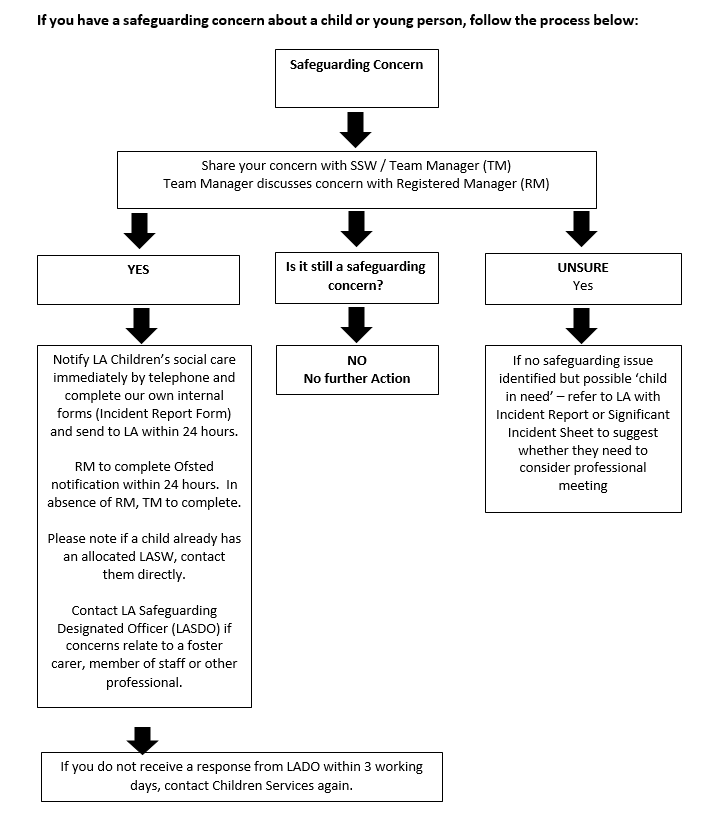
Whistleblowing and Escalation
If any staff member or foster carer has reported a safeguarding concern to their Positive Aspirations manager and feels unheard or that no action is being taken, they should follow the Whistleblowing procedure.
If any staff member or foster carer has reported a safeguarding concern to the Local Authority (LA) and feels unheard or that no action is being taken, the concern must be escalated to the Positive Aspirations Team Manager, who will raise the matter with the LA Team Manager.
If the LA still takes no positive action to safeguard a child, the concern must be reported to the Registered Manager, who will escalate it to the LA Service Manager.
If action to protect a child remains absent, consideration should be given to referring the matter to the Local Authority Designated Officer (LADO) and initiating the LA Whistleblowing policy.
Ultimately, if the LA does not act to protect a child despite being informed of the risk, the Registered Manager must report the matter to the duty inspector at Ofsted.
Contextual Safeguarding
We recognise that safeguarding children extends beyond protecting them from harm in their immediate home environment and includes addressing wider factors that may place them at risk. These factors include:
- Peer relationships (for example, bullying or peer-on-peer abuse)
- Online safety (for example, exposure to online harms or inappropriate content)
- Community factors (for example, gang violence or exploitation)
- Other external influences that may affect the child’s safety and wellbeing
The agency embeds contextual-safeguarding principles in risk assessments and care plans so that the broader environment and social dynamics around each child are carefully considered.
Recruitment and Assessment of Staff and Foster Carers and Their Household
All staff and foster carers are recruited and assessed in full accordance with Positive Aspirations’ Safer Recruitment and Recruitment and Assessment Policies and Procedures. Our recruitment process follows the Fostering Services (England) Regulations 2011, National Minimum Standards 2011, Working Together guidance, the Safeguarding Vulnerable Groups Act 2006, and Safer Recruitment guidelines. All staff and foster carers are subject to the same processes.
Staff and Carer Training
All staff and foster carers undertake mandatory, comprehensive training on safeguarding and safer-caring practices. Full details of expected training are set out in the Positive Aspirations Training and Development Policy.
Placement Planning and Risk Assessment
Bedroom Arrangements and Living Space
- Each fostered child over age three should have their own bedroom unless sharing with siblings is assessed at the time of placement and agreed by the local authority.
- Decisions about bedroom sharing must consider the needs, wishes, and safety of every child involved, especially where there is a history of abuse or additional vulnerability.
- Bedrooms must provide sufficient personal space, an appropriate bed, and storage for clothing and belongings.
- The home must support children’s privacy, study, and play, both indoors and outdoors.
- While Positive Aspirations’ policy allows a foster carer to share a bedroom with a baby under three, such arrangements are approved on a case-by-case basis.
- Any change in household composition (for example, an adult child returning home) must be reported, and statutory checks will be completed.
Information sharing and planning processes are crucial to ensuring that placements are safe and meet the needs of all children involved.
Positive Aspirations’ Matching Policy places significant emphasis on thorough matching and carefully considers, during assessment and review, the appropriateness of foster carers’ terms of approval and preferred matching criteria.
Realistic Placement Plans—including risk assessments, safer-caring guidance, delegated-authority arrangements, and behaviour-management strategies—are developed as integral parts of the Placement Plan to reassure the child or young person, the foster carer, and the placing authority that everyone’s welfare and requirements are safeguarded.
Where any of the eight identified risk categories may be present, a risk matrix is completed to inform the safer-caring policy.
Supervision and Support to Carers
The Positive Aspirations Supervision and Support of Foster Carers Policy guides all supervising social workers (SSWs).
All foster carers have an allocated SSW from the agency’s locality teams. SSWs visit foster carers at the time of, or within 72 hours of, a new placement and then at least monthly while a child or young person remains in placement. Additional contact is maintained through meetings, training, support groups, telephone, or email.
Formal supervision takes place at least every two months. These sessions review the current placement, reflect on experiences, and plan for future work or development, confirming appropriate child-protection and safer-caring responses.
Supervision records inform the annual foster-carer review. Feedback and recommendations from the review are presented to the agency’s Decision Maker or the Fostering Panel each year to ensure regular monitoring of all approved carers. Detailed guidance on support, supervision, training, and skills development is provided in the foster-carer supervision and training guidelines.
24-Hour Advice and Support
The 24-hour advice and support service offers an additional safeguard for all placements. Foster carers can contact their SSW, locality manager, or a senior on-call manager for advice, reassurance, or information about child-protection or safer-caring matters. Where formal notification to the placing authority or another agency is required, agency staff advise carers and ensure significant events are reported and managed safely.
Safe Care for All Children
All staff, foster carers, and support workers are committed to ensuring every child receives the highest level of protection and support. While always considering the best interests of any child who has experienced or caused harm, we give equal priority to safeguarding other children and young people in the foster carer’s family, other foster children, and children in the wider community.
We encourage every child to participate fully in therapeutic programmes or other processes related to their experiences and support carers, children, and social workers in advocating for the best possible services and resources.
The fostering bedroom must be large enough to give each child private space, with room for a wardrobe and chest of drawers. Consideration must also be given to where children will complete homework and where they will play inside and outside the home.
Safer Caring
The agency is dedicated to fostering a culture of safety and vigilance in all foster homes. All foster carers must complete mandatory training in safeguarding and safer-caring practices to ensure they have the knowledge and skills to protect children and respond appropriately to concerns.
Every foster carer must have a Household Safer Caring Policy from the time of approval, reflecting the specific dynamics, routines, and risk-management approaches within their household.
Each child placed with a foster carer has an Individual Child Safer Caring Plan tailored to their unique needs and circumstances. These plans are reviewed every 6 months—sooner if there is a significant incident, accident, or change—so safeguarding strategies remain current, relevant, and effective.
Staff members who have direct contact with young people must apply safer-caring principles and practices regarding travel and transport, bedroom arrangements, ensuring the foster parent is present during supervisory visits, and visits to public places.
Safer Caring Principles and Staff Contact with Young People
To keep every child and young person safe and well, all direct contact by staff must follow the agency’s Safer Caring principles. The guidance below explains how those principles apply in key situations.
Travel and Transport
Staff members must:
- Make sure every journey happens in a road-worthy, legal, and suitable vehicle.
- Use effective safer caring principles for a vehicle, not limited to; child in the back seat, in an appropriate harness or restraint/seat belt
- Travel or trips that are 1-1 with a child MUST be recorded with details of interactions/conversations
Bedrooms and Sleeping Arrangements
- No staff member or visitor may go into a child’s bedroom without permission unless there is an immediate safety risk; any such entry must be recorded under safeguarding protocols.
Supervisory Visits
- A foster carer should be in the home for every supervisory visit unless an agreed exception is in place.
- Carers must help supervise the visit to protect the child’s welfare.
- Any concern raised during the visit must be dealt with at once, documented clearly, and shared with all relevant people.
Public Places and Outings
- Every outing must be approved in advance by the manager and planned with safety in mind.
- A risk assessment must be completed for each trip, taking the child’s needs and vulnerabilities into account.
- Staff must always know where children are and have up-to-date contact details in case of emergency.
Safeguarding Children Is Everyone’s Business
All agency policies, procedures, and training exist to help everyone understand and apply safeguarding principles in everyday practice.
Complaints, Concerns and Allegations
Clear steps for staff, foster carers, and children set out what to do if they are worried about abuse or neglect. These steps are detailed in the Allegations and Complaints Policy and Procedures.
The Children’s Guide encourages children and young people to share concerns with the agency, their local authority, or external bodies such as Ofsted.
Every concern is taken seriously, shared with the right organisations, and investigated under the law, current guidance, and agency procedures. Allegations against staff or carers follow Working Together to Safeguard Children 2026. The agency consults the Local Authority Designated Officer (LADO) to agree the scope of each allegation and works closely with the local authority throughout.
De-Registration of Foster Carer/s
Positive Aspirations values each fostering family and offers support wherever possible. However, a family may be de-registered when:
- They have not fostered for an extended period and show no intention of returning soon.
- The working relationship between the foster family and Positive Aspirations (or its partner agencies) has broken down beyond repair.
- A Standards of Care investigation recommends an early review that then recommends de-registration.
- A foster-home review recommends de-registration.
- The family’s actions bring Positive Aspirations or its partner agencies into disrepute.
When de-registration is considered, Positive Aspirations will:
1a. Speak openly with the family before any decision is made.
1b. Explain the reasons clearly and invite discussion.
1c. Provide reports for Panel early enough for the family to decide whether to accept or challenge the proposal.
Written procedures are also in place for any complaint raised by or for children, young people, or foster carers. Regular feedback from children and young people informs service improvement. The whistle-blowing policy lets anyone report conduct that may harm children’s welfare.
All policies, procedures, and training programmes are reviewed through a safer-care lens. Senior management records and analyses every allegation’s circumstances and outcome, using this information—and current external guidance—to strengthen safeguarding practice.
The agency aims to build a workplace culture that supports safety and challenges harassment, bullying, or intimidation. Adults model respectful behaviour, and service settings meet health and safety standards for everyone.
Whistleblowing
The agency’s Whistleblowing Policy is shared with all staff, foster carers, panel members, and others working with the agency. It makes clear that they must report to an appropriate authority any situation in the fostering service that could seriously harm a child’s safety, rights, or welfare.
Ofsted
Anyone—staff member, carer, or young person—may contact Ofsted or their local Children’s Services Department if they are worried about a child’s welfare or safety. Raising such concerns will not lead to negative consequences or reprisals.
Ofsted contact details:
Piccadilly Gate
Store Street
Manchester
M1 2WD
Telephone: 0300 123 1231
Email: enquiries@ofsted.gov.uk


